
Thermomechanical analysis
DMA Tester
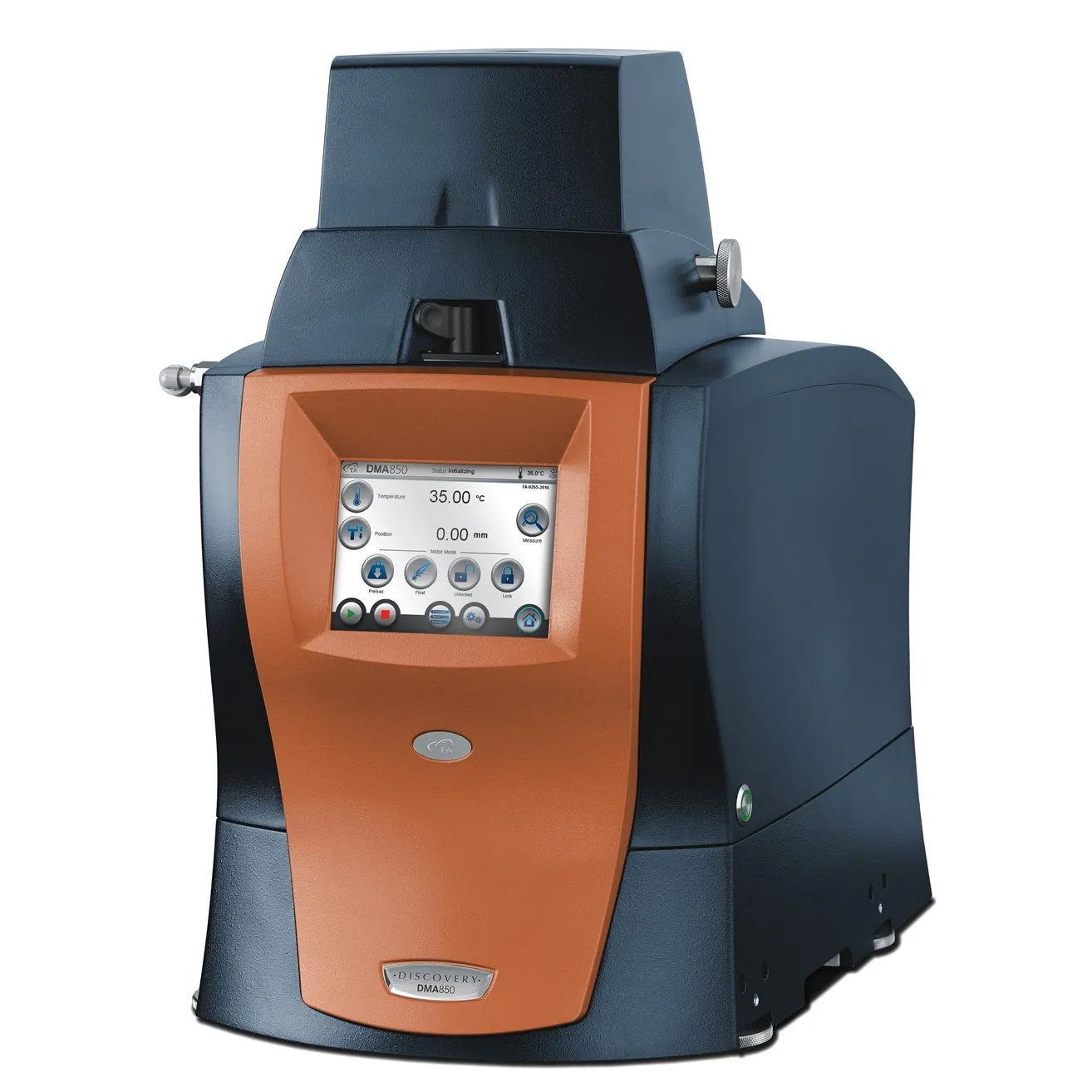
TA Instruments Discovery DMA 850
Dynamic mechanical analysis applies a small oscillating deformation and measures the response. The result is the storage modulus E′, the loss modulus E″ and their ratio tan δ as a function of temperature, frequency or time.
A non-contact drive motor on air bearings applies forces from 0.1 mN without friction, and 0.1 nm displacement resolution covers soft elastomers and stiff PEEK alike. Tension, compression, bending and shear clamps match the geometry of the part.
Key specifications
−100 to 600°C
Temperature range
0.0001–18N
Force range
0.001–200Hz
Frequency range
0.1nm
Displacement resolution
- Modulus range
- 10³ to 3×10¹² Pa
- Modulus precision
- ±1 %
- Tan δ sensitivity
- 0.0001
- Clamps
- Tension, compression, bending, shear
Performance data from TA Instruments Discovery DMA 850 specifications; temperature range as installed.
Typical applications
- Temperature-sweep stiffness (storage modulus)
- Glass transition temperature (E″ peak, tan δ peak, onset)
- Brittleness temperature
- Sub-Tg (beta) transitions
- Rubbery plateau and crosslink density
- Terminal region: melting and softening
- Frequency dependence and master curves
- Damping behavior of elastomers
- Creep and stress relaxation
- Effect of aging and fluid exposure on modulus
- Viscoelastic material models for FEA
- Composite stiffness and fiber-matrix interaction
Example outputs
1
PEEK through its glass transition
The storage modulus holds steady, then falls as PEEK passes its Tg near 150 °C while E″ and tan δ peak. Above that point a backup ring loses much of its stiffness, which sets its extrusion limit at temperature.
2
FKM glass transition
The modulus drops by three decades as the FKM passes from glassy to rubbery, and tan δ peaks in between. Below this region the seal is too stiff to follow the gland, a more realistic low-temperature limit than a datasheet value.