
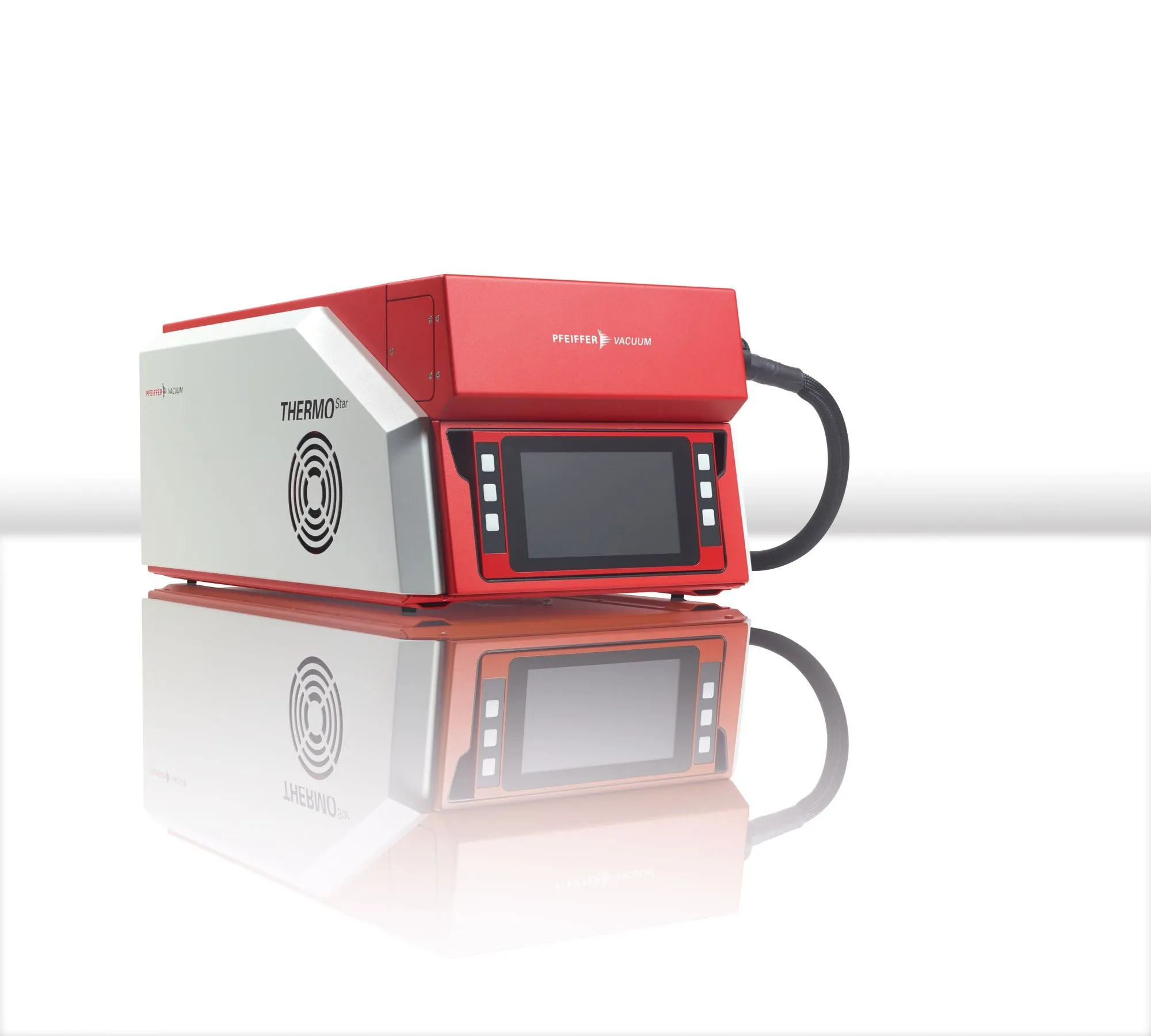
Evolved gas analysis
QMS Mass Spectrometer
TA Instruments Discovery MS
A quadrupole mass spectrometer ionizes the gas leaving the thermobalance and sorts the fragments by mass-to-charge ratio. Connected through a heated capillary, it samples the off-gas continuously, so every mass-loss step comes with its own set of ion currents.
Plasticizers, curing by-products, residual solvents and decomposition products each show characteristic fragments at the temperature where the TGA records the loss. For fluoropolymers, HF and fluorinated fragments are followed directly.
Key specifications
1–300u
Mass range
<100ppb
Detection limit
1ms/u
Scan speed, fastest
200°C
Heated capillary inlet
- Analyzer
- Quadrupole, electron ionization
- Inlet
- Two-stage, heated capillary from TGA
- Gas consumption
- 1–2 sccm
- Data
- Ion currents synchronized with TGA mass loss
Typical performance of a TGA-coupled quadrupole gas analyzer; installed configuration may differ.
Typical applications
- Identification of species behind each TGA mass-loss step
- Plasticizer and additive families in elastomers
- Cure by-products and residual volatiles
- Residual solvents and moisture
- Outgassing of seals for vacuum and cleanroom service
- HF and fluorinated fragments from FKM, FFKM and PTFE
- PFAS-related screening of fluoropolymer compounds
- Decomposition pathways of polymers
- Contaminants in service-returned parts
- Reverse engineering of unknown compounds
Example outputs
1
Evolved gases from NBR
The early, low-temperature signal is plasticizer leaving before the polymer breaks down, the evidence behind shrinkage and hardening in service.
2
Evolved gases from FKM
HF (m/z 20) and fluorocarbon fragments appear only as the polymer backbone decomposes, well above the service temperature.