
08/ 11
Elemental analysis
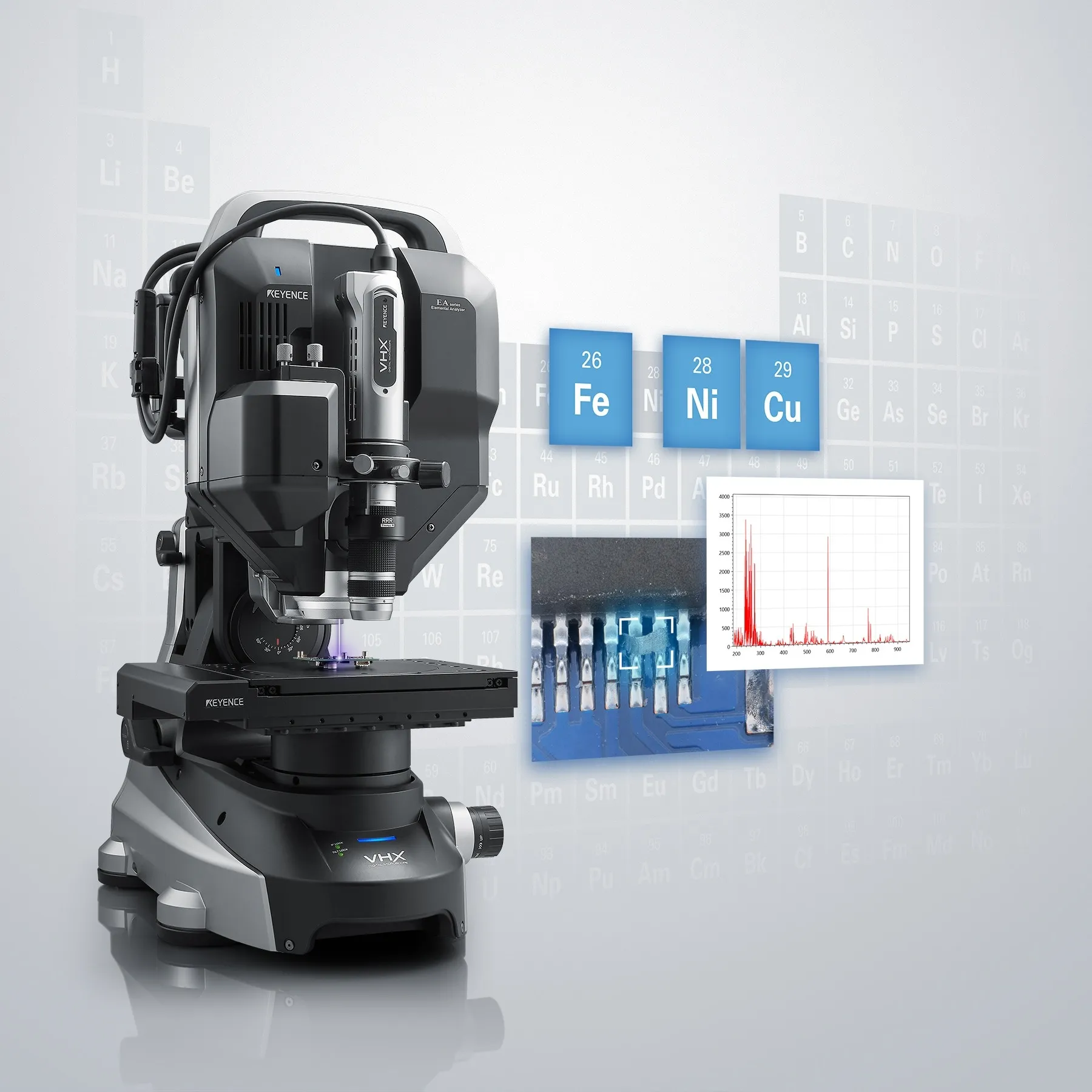
LIBS Elemental Analyzer
Keyence EA-300
Laser-induced breakdown spectroscopy focuses a short laser pulse on the sample.
The analyzer mounts on the digital microscope, so a feature is imaged and analyzed in the same position.
A
Key specifications
H–U
Detectable elements, hydrogen to uranium
~10µm
Analysis spot and mapping resolution
355nm
Laser wavelength, Class 1 system
40 × 40mm
Scan area
- Sample size
- Up to 250 × 250 × 30 mm, 1 kg
- Cameras
- Low-mag 20–200×; LIBS camera 300–1000×
- Preparation
- None; no vacuum or coating
- Software
- Material suggestion, results database
Based on Keyence EA-300 specifications.
B
Typical applications
- Elemental identity of particles and inclusions in seals
- Metal debris from processing or service hardware
- Inorganic fillers and pigments in compounds
- Scale, corrosion products and deposits on seal surfaces
- Elemental mapping across fracture surfaces
- Depth profiling of surface layers and coatings
- Unexpected elements in incoming material
- Contamination in molded and machined parts
- Support for root-cause analysis of failed components
- Screening of composite reinforcements and fillers
C
Example outputs
1
Emission spectrum of a particle
Cobalt, nickel, iron and aluminum emission lines identify a metallic alloy.
2
Particle composition
An Al–Ni–Co alloy identifies processing equipment as the source of contamination.