
Thermal analysis
TGA Thermobalance
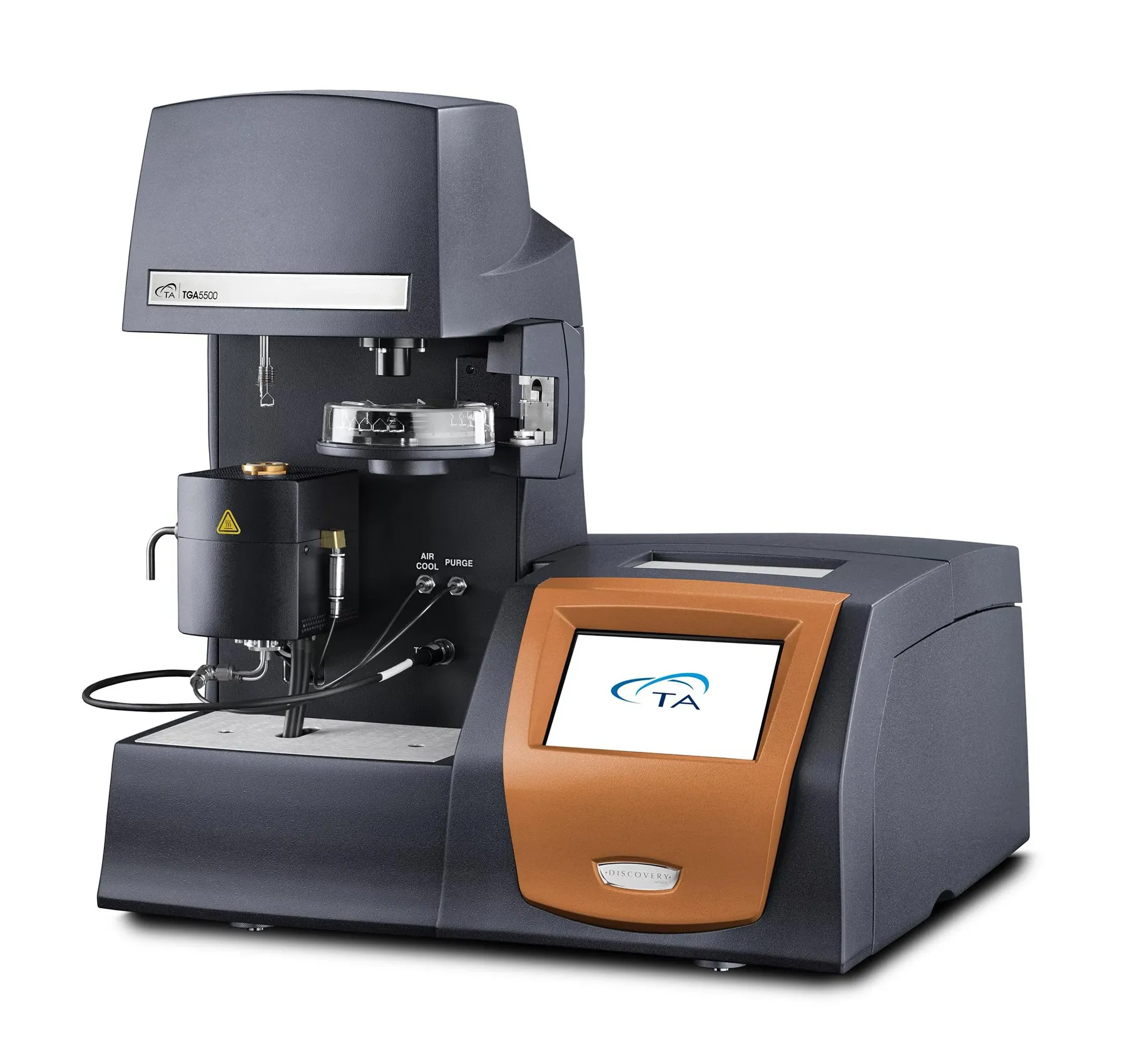
TA Instruments Discovery TGA 5500
Thermogravimetric analysis records the mass of a sample with sub-microgram resolution as it is heated in a controlled atmosphere. Each step in the curve corresponds to a component leaving the sample: moisture, plasticizer, polymer, carbon black; the residue is inorganic filler and ash.
The infrared furnace heats at up to 500 °C/min and cools from 1200 °C in under ten minutes. A switchable purge gas allows nitrogen-to-air changes within a run, and the heated outlet couples the balance to the mass spectrometer or FTIR for evolved gas analysis.
Key specifications
Up to 1200°C
Temperature range
0.008µg
Weighing resolution, 100 mg range
<10µg
Baseline drift, ambient to 1000 °C
25
Autosampler positions
- Heating rate
- 0.01 to 500 °C/min
- Balance capacity
- 1000 mg, Tru-Mass dual range
- Signals
- TGA, DTG, DTA
- Test modes
- Hi-Res, Modulated TGA, Auto-Stepwise
Performance data from TA Instruments Discovery TGA 5500 specifications.
Typical applications
- Compositional analysis of compounds and blends
- Polymer, plasticizer and carbon black content
- Filler and ash content (glass, graphite, bronze, pigments)
- Fingerprinting of unknown polymers
- Thermal stability and decomposition temperature
- Oxidative stability
- Decomposition kinetics
- Moisture and volatiles content
- Effect of reactive atmospheres on materials
- Estimation of product lifetime
- Evolved gas analysis with QMS or FTIR
- Batch-to-batch consistency of PTFE compounds
Example outputs
1
Filled PTFE decomposition
A single mass-loss step as the PTFE matrix decomposes, followed by a flat plateau. The plateau height is the filler content, a direct check that a glass-, carbon- or bronze-filled grade contains what the specification requires.
2
FKM composition with DTG
The DTG peaks separate the mass loss into its parts: polymer first, then carbon black burned off in air, then the inorganic residue. The three fractions add up to the compound recipe.